How to reduce the cost of ownership… workforce and IT team management

Last updated: 4.3.2026
Key Summary (TL;DR)
Companies are reducing the cost of owning IT workforce and managing teams through nearshoring (Auxis estimates an average of 30% savings versus onshoring), offshoring (Amberg et al. report up to 50% savings) or SLA optimization. The deployment of automation and AI leads up to 100% streamlining of some activities and processes.
Artificial intelligence is a popular tool for everything today. It is true that it can help optimize costs, but it is not the only way. An analysis of the operations and needs of the company will help show which optimization tools are the most suitable ones.
The most common goal of management is to automate routine tasks, reduce hourly labor costs or increase efficiency for the same price. These tools enable work with company finances. In addition, correctly selected procedures are reflected in improved operational continuity.2
However, optimization in IT is not only about benefits for individual aspects of the company. If they are set up correctly, they support company strategies and business goals, which is ultimately the most important thing.
How do nearshoring and offshoring reduce labor costs in IT?
The word outsourcing is too general for specific activities. Therefore, it is necessary to divide it into two subcategories – nearshoring and offshoring. Both are approaches where a company transfers part of the tasks to teams or workers in areas where wages or costs are lower.
Nearshoring is the use of countries that are in the same or a close time zone. People there often live in a similar cultural environment. However, labor costs are lower there. This achieves simultaneous effective cooperation with lower costs.
The basis for successful nearshoring is careful selection of the location. Exchange rates, the legal environment or political stability play a role in the selection.3 However, the benefits can be significant. Auxis estimates up to 30% savings compared to local teams.4
Offshoring is recruitment in a distant country where labor costs are significantly lower. Despite the obstacles that may arise from cultural background, language, or time difference, this approach can bring savings of up to 50%, according to Amberg et al. The company must therefore weigh the savings on the one hand and the negatives associated with a specific location on the other.
Whichever approach a company decides to take, if it is handled correctly, it can significantly reduce costs. However, it must consider whether alternatives such as onshore outsourcing (hiring a local company) or the use of modern automation and AI tools will not achieve the same or better results.
How do nearshoring and offshoring differ?
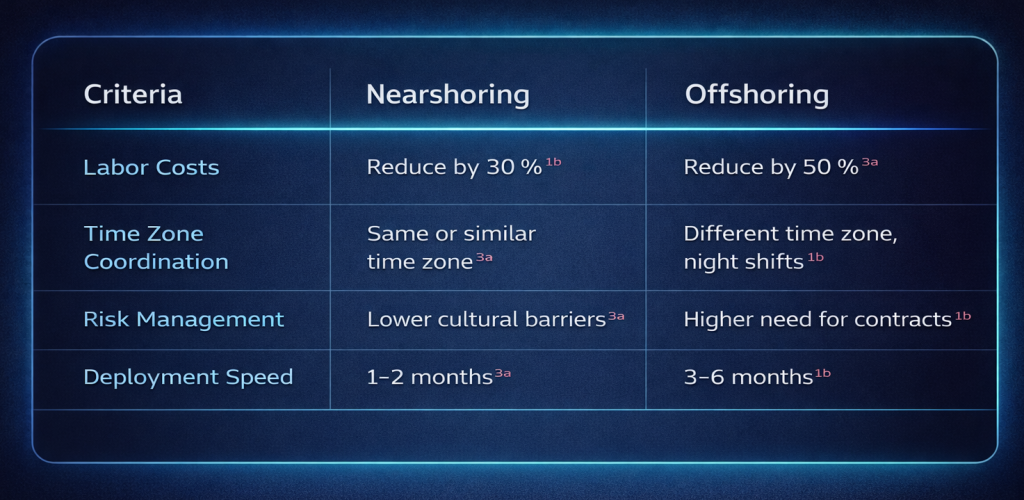
Note: superscripts refer to sources listed below the article.
How does automating repetitive tasks improve the functioning of IT teams?
Routine often annoys employees. They feel like robots. But why not hand over these activities to robots?
Currently, there are many automation tools, including specialized applications for specific departments. The most common terms used are RPA and RAG.
Robotic process automation (RPA) accurately describes its purpose by its name. Companies use RPA to automate routines. This can include simple data entry and business workflow operations. However, in this AI day and age it is not enough to just automate “manual” IT work.
That is why companies widely use retrieval augmented generation (RAG). Unlike RPA, RAG can work with unstructured data. Therefore it delivers automatic work and automatic thinking.6
It is not just about using artificial intelligence. It is a combination of tools supported by artificial intelligence functions.
The benefits of these technologies cannot generally be expressed in numbers. It depends on the purpose for which the company deploys them and what ROI they use. However, if we look at the list of benefits and their quantification, then we are looking at savings in tens of percent.
It is true that these technologies require some time to implement. However, their benefits are not only at the level of savings. Thanks to RPA and RAG, companies are able to increase productivity, reduce errors and improve compliance, just to name a few.7
Does SLA optimization affect IT costs?
If your company belongs to the technology sector, then you know the role of SLA. But today’s article allows you to perceive this document as a key business and strategic tool.
SLA should be as specific as possible, because it is a binding legal document. Thanks to this, your team knows exactly what to do at which moment. This document also clearly determines the level of criticality of individual requirements. If someone has paid for a higher SLA level, they have priority. Without SLA, however, the team would focus on every incident with the same priority.
SLAs help increase revenue by charging for more demanding activities. They also have an impact on the quality of customer care and customer retention. This not only contributes to cost optimization, but also brings in additional business.8
How does management change its perspective?
Previously, metrics were clear – the number of hours or tasks. However, current technologies have changed this trend. Company management is increasingly focusing on the total cost of operation and also aspects that cannot be expressed in financial terms at first glance.
The choice of operating model is influenced by data sensitivity, privacy protection, compliance with legal obligations, security, efficiency, productivity, suitable facilities for employees and risks. Nearshoring and offshoring offer the opportunity to reduce the costs of tasks that can be performed outside the company’s secure facilities. Automation, RPA, and RAG make the work of internal employees more efficient. Properly set SLAs, in turn, lead to the correct allocation of technicians’ time and prioritization of tasks.
All of these tools, processes, and procedures can contribute to the efficient management of company finances. However, each company must consider the mix that will be beneficial to it. There is no universal answer.
Citations
1
Leveraging the Talent and Cost Advantages of IT Nearshoring – https://www.auxis.com/cost-advantages-of-it-nearshoring/
Robotic Process Automation (RPA): What is it, and what … –
https://vantage365.com/robotic-process-automation/
Rightsizing SAP Support Levels to Optimize Cost and SLA Coverage –
https://redresscompliance.com/rightsizing-sap-support-levels-to-optimize-cost-and-sla-coverage/
d Reduce software development costs by 30% with Nearshoring –
https://www.cleveritgroup.com/en/blog/reduce-software-development-costs-by-30-with-nearshoring
Robotic Process Automation (RPA): Cut Operational Costs 40 … –
https://skilledprompt.com/robotic-process-automation-rpa-streamlining-business-operations/
SLA Review Guide for Early-Stage Startups –
https://maccelerator.la/en/blog/entrepreneurship/sla-review-guide-for-early-stage-startups/
2
Robotic Process Automation (RPA): Cut Operational Costs 40 … –
https://skilledprompt.com/robotic-process-automation-rpa-streamlining-business-operations/
Rightsizing SAP Support Levels to Optimize Cost and SLA Coverage –
https://redresscompliance.com/rightsizing-sap-support-levels-to-optimize-cost-and-sla-coverage/
Robotic Process Automation (RPA): What is it, and what … –
https://vantage365.com/robotic-process-automation/
SLA Review Guide for Early-Stage Startups –
https://maccelerator.la/en/blog/entrepreneurship/sla-review-guide-for-early-stage-startups/
Leveraging the Talent and Cost Advantages of IT Nearshoring – https://www.auxis.com/cost-advantages-of-it-nearshoring/
3
aLeveraging the Talent and Cost Advantages of IT Nearshoring – https://www.auxis.com/cost-advantages-of-it-nearshoring/
Risks and Benefits of Nearshoring vs Offshoring in Outsourcing –
https://vorecol.com/blogs/blog-risks-and-benefits-of-nearshoring-vs-offshoring-in-outsourcing-10492
Lower your Onshore Team Expenses with Nearshoring –
Nearshore vs Offshore Outsourcing in 2025: Pick Wisely –
https://www.netguru.com/blog/nearshore-vs-offshore-outsourcing
Nearshoring vs Offshoring: A Strategic Guide for 2025 IT Outsourcing –
https://www.index.dev/blog/it-nearshoring-vs-offshoring
4
Risks and Benefits of Nearshoring vs Offshoring in Outsourcing –
https://vorecol.com/blogs/blog-risks-and-benefits-of-nearshoring-vs-offshoring-in-outsourcing-10492
5
Risks and Benefits of Nearshoring vs Offshoring in Outsourcing –
https://vorecol.com/blogs/blog-risks-and-benefits-of-nearshoring-vs-offshoring-in-outsourcing-10492
6
Bridging Intelligence with Automation: Real-World Use Cases of RAG in RPA – https://www.linkedin.com/pulse/bridging-intelligence-automation-real-world-use-cases-pradeep-wani-lmfkf/
7
Robotic Process Automation (RPA): What is it, and what … –
https://vantage365.com/robotic-process-automation/
How Robotic Process Automation can reduce labor costs –
https://ggsitc.com/blog/robotic-process-automation-reduce-labor-costs
Labor Cost Savings from Automation: Stat Breakdown –
https://patentpc.com/blog/labor-cost-savings-from-automation-stat-breakdown
Maximize Efficiency with RPA: Save Time Now! –
8
Rightsizing SAP Support Levels to Optimize Cost and SLA Coverage –
https://redresscompliance.com/rightsizing-sap-support-levels-to-optimize-cost-and-sla-coverage/
SLA Review Guide for Early-Stage Startups –
https://maccelerator.la/en/blog/entrepreneurship/sla-review-guide-for-early-stage-startups/
How ServiceNow ITSM Reduces IT Costs and Improves SLA Efficiency –
https://ctrlaltnow.com/how-servicenow-itsm-reduces-it-costs-and-improves-sla-efficiency/
How SLA Agreements Can Drive Cloud Cost Optimization –
https://www.priz.ai/post/how-sla-agreements-can-drive-cloud-cost-optimization